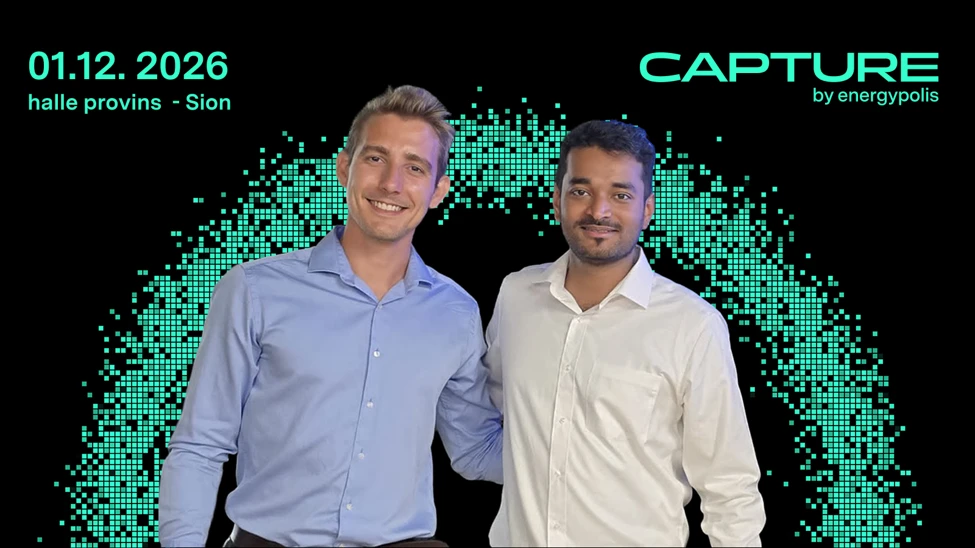
Cement plants live with two problems they would rather not have: the CO₂ that leaves their chimneys, and the mineral waste that comes back from construction sites. DeltaSpark, an EPFL spin-off founded by Luc Bondaz and Suhas Nuggehalli Sampathkumar, wants to turn both into something a cement plant can use. On 1 December, the team exhibits at CAPTURE by Energypolis in Sion.
« We turn construction waste and CO₂ into valuable raw materials for the cement industry, » says Luc Bondaz, CEO and co-founder of DeltaSpark.
Rock weathering, in minutes
Rocks capture CO₂ naturally as they weather, but over very long periods. DeltaSpark speeds up that reaction with electrolysis: CO₂ becomes solid minerals in minutes, and hydrogen is produced along the way.
« For an industrial emitter, this means smaller equipment can process more CO₂, reducing the space needed and potentially lowering investment costs, » the founders explain. « Speed helps make permanent carbon storage practical at the factory itself. »
One container, then many
DeltaSpark’s unit fits in a shipping container and sits at the emission source. A first deployment would treat a small share of a plant’s emissions, to validate performance under real operating conditions. The team then plans to scale each container up to a target of multiple tonnes of CO₂ a day, and to add containers in compact arrangements, with the aim of capturing all the emissions of a site.
Cheaper than emitting
Swiss cement plants are covered by the emissions trading system, where emitting a tonne of CO₂ costs a little over CHF 70. DeltaSpark’s target is a subscription below CHF 50 per tonne permanently stored: a saving of more than CHF 20 per tonne.
The process also produces hydrogen and building materials, which the cement plant can use directly. DeltaSpark is targeting a price of CHF 1 per kilo for the hydrogen, and competitive prices for the materials.
“Our answer is to demonstrate it together”
The concern DeltaSpark hears most from industrials is that the technology hasn’t been proven at scale yet. “That’s fair, and our answer is to demonstrate it together,” says Luc Bondaz. “We see a strong willingness from cement producers to work with us on that next step. Scaling requires real industrial conditions, operational expertise and close collaboration. We build confidence through progressively larger deployments, measuring performance at each stage.”
What you’ll see at their booth
On 1 December, visitors will meet the DeltaSpark team and see the materials it produces from CO₂ and mineral waste, with an explanation of how the process works and how it is coming to industrial sites.
The question to ask them: how can you turn two major industrial liabilities, CO₂ emissions and mineral waste, into economic value?
Who Luc and Suhas want to meet in Sion
The team is particularly keen to meet cement and waste-to-energy companies interested in hosting a pilot, and investors who would like to join its funding round. « We’re happy to meet anyone curious about DeltaSpark, » they add.
Want to meet the DeltaSpark team?
Come and see them at CAPTURE by Energypolis, on 1 December 2026 at the Halle Industrielle Provins in Sion. Register with the code H2OUT to get 40% off your ticket.
Programme and registration: https://capture.energypolis.ch/